When Does a Baby Anaconda Have to Find Their Own Food
Anaconda: Habits, hunting and nutrition
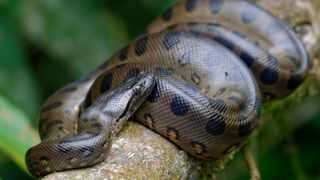
Anacondas are semi aquaticsnakes found in tropical South America, notable in the Amazon and dissimilar to pythons. They are some of the largest snakes in the world and are known for their swimming power. "Anaconda" is the common name for the genus Eunectes, a genus of boa. Eunectes means "proficient swimmer" in Greek, according to SeaWorld.
At that place are four recognized species of anaconda, co-ordinate to Pecker Heyborne, a herpetologist and professor of biology at Southern Utah University. They are the light-green anaconda, the xanthous or Paraguayan anaconda, the dark-spotted anaconda and the Beni or Bolivian anaconda. "They can be differentiated from i some other genetically, but also based on their size and geographic range," Heyborne said.
Heyborne said that when well-nigh people say anaconda, they are actually referring to the light-green anaconda, the largest of the 4 species. The greenish anaconda is the heaviest snake in the world and one of the longest.
Co-ordinate to the Mythology.net , anacondas feature prominently in S American myths, sometimes appearing as shapeshifters , every bit the creator of the water, as cruel man-eaters, or every bit magical, spiritual beings with healing backdrop.
In that location accept also been reports of anacondas reaching lengths of 40, 50 and 100 feet (12, 15 and 30 meters) — far longer than anything scientifically verified. These reports accept given ascent to the Giant Anaconda myth, popularized in the early 20th century by explorers and colonists, according to Loren Coleman and Jerome Clark'due south "Cryptozoology A to Z".
Concrete characteristics
Anacondas are stocky, muscular snakes that are thicker than other boas, according to Reptiles Cove. They have thick necks and narrow but big heads. All anacondas accept nostrils and eyes on the tops of their heads, which allow them to see in a higher place the h2o while remaining mostly submerged. They have a thick black stripe that runs from the center to the jaw.
Anacondas accept modest, smooth scales that grow larger toward the posterior of their bodies. They have loose, soft skin that can handle a cracking bargain of water absorption, according to the University of Michigan'south Animal Diversity Web (ADW).
Taxonomy/classification
The taxonomy of anacondas, according to the Integrated Taxonomic Data Organization (ITIS), is:
Kingdom: Animalia Subkingdom: Bilateria Infrakingdom: Deuterostomia Phylum: Chordata Subphylum: Vertebrata Infraphylum: Gnathostomata Superclass: Tetrapoda Course: Reptilia Order: Squamata Suborder: Serpentes Infraorder: Alethinophidia Family: Boidae Genus: Eunectes
Near their cloacal region, anacondas accept spurs on their scales. Males have larger spurs than females, though females are overall larger and longer snakes. In fact, anacondas showroom the largest sexual dimorphism (with the female person being larger) of any tetrapod species, according to Jesus Rivas, a herpetologist and founder of the Anaconda Project.
Anacondas' coloring and size depends on the species. Their spotted, light-green, yellow and brown colour palettes permit them to blend in with tropical rivers and rainforests, co-ordinate to Sciencing.
Species of anaconda
Green anaconda ( Eunectes murinus )
True to their proper name, these are dark-green-brown, olive, or dark-green-gray. They accept blackness or brown egg-shaped spots on the mid-to posterior back of their bodies. Their sides are sometimes more yellow than greenish with egg-shaped spots with yellow centers, according to the Jacksonville Zoo.
Green anacondas' length is still a matter of argue, said Heyborne. They are quite difficult to measure. Information technology is hard to stretch out a convict anaconda, not to mention potentially unsafe for the serpent, according to Rivas. People who encounter anacondas in the wild are probable to overestimate their length due to fright. Too, an anaconda that has recently eaten will look much larger than ane that hasn't, causing exaggerated estimations of size. Furthermore, the skins of expressionless snakes can be stretched, pregnant that it is hard to scientifically verify the length of those, too, peculiarly historical samples, according to Wonderpolis.
While many publications, including National Geographic and the San Diego Zoo list anacondas' maximum verified length as 29 or 30 feet (9 k), Rivas, who has captured and measured more than 1,000 anacondas, believes they don't grow much longer than 20 anxiety (6 m). The Guinness Book of World Records lists the longest ophidian ever recorded as a 25-foot (7.6 k) reticulated python.
The boilerplate size of female anacondas is around fifteen feet (four.5 m), and the average size of males is around ix anxiety (2.7 m), co-ordinate to Boas and Pythons of the World.
Weights are as well non known for certain. Estimates meridian out at about 550 lbs. (250 kilograms), according to National Geographic, but the average is probably somewhere between 100 and 150 lbs. (45 and 68 kg), according to "The Lives of Amphibians and Reptiles in an Amazonian Rainforest" (Cornell, 2005) by William E. Duellman.
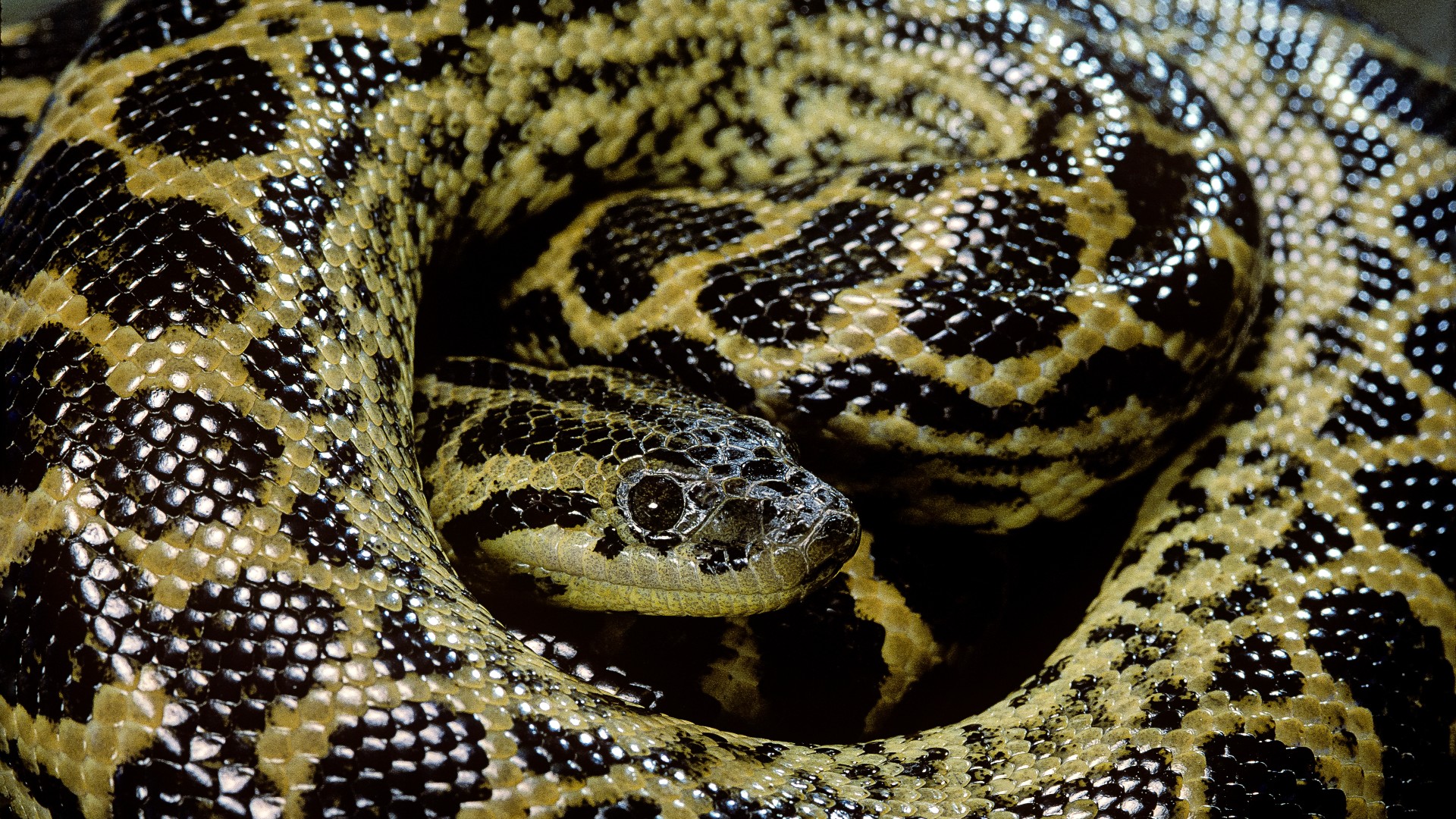
Yellow anaconda ( Eunectes notaeus )
Yellow anacondas have yellow, golden-tan, or yellow-green coloring with black or dark brown blotches, spots, streaks, and dorsal bands. Each snake has a unique blueprint of yellowish and blackness scales on the bottom of its tail. The average length is about nine anxiety (2.7 chiliad), according to the World Country Trust.
Beni or Bolivian anaconda ( Eunectes beniensis )
Not much is known about these anacondas, which were long considered a hybrid of yellow and green anacondas until scientists adamant they were their own species. Their coloring is similar to the dark-green anaconda, according to World Atlas
Dark-spotted anaconda ( Eunectes deschauenseei )
These anacondas accept dark chocolate-brown or black spots on a brown background and abound to exist about 9 feet (2.7 one thousand) long, according to Charlotte Penhaligan in "Snakes: Essential Wildlife" (Character 19, 2021).
Anaconda in the wild
All anacondas live in South America due east of the Andes. Green anacondas are institute in the Brazilian Amazon basin, the Orinoco basin, Colombia, Venezuela, Ecuador, Peru, Bolivia, Trinidad and the Guianas, Jacksonville Zoo states.
Yellow anacondas alive in Paraguay, southern Brazil, Bolivia and northeastern Argentina, according to ADW. The Beni or Bolivian anaconda is establish but in a modest role of Bolivia, according to the San Diego Zoo. The dark-spotted anaconda lives in Brazil and French Guiana, according to the International Spousal relationship for Conservation of Nature (IUCN).
Natural habitat
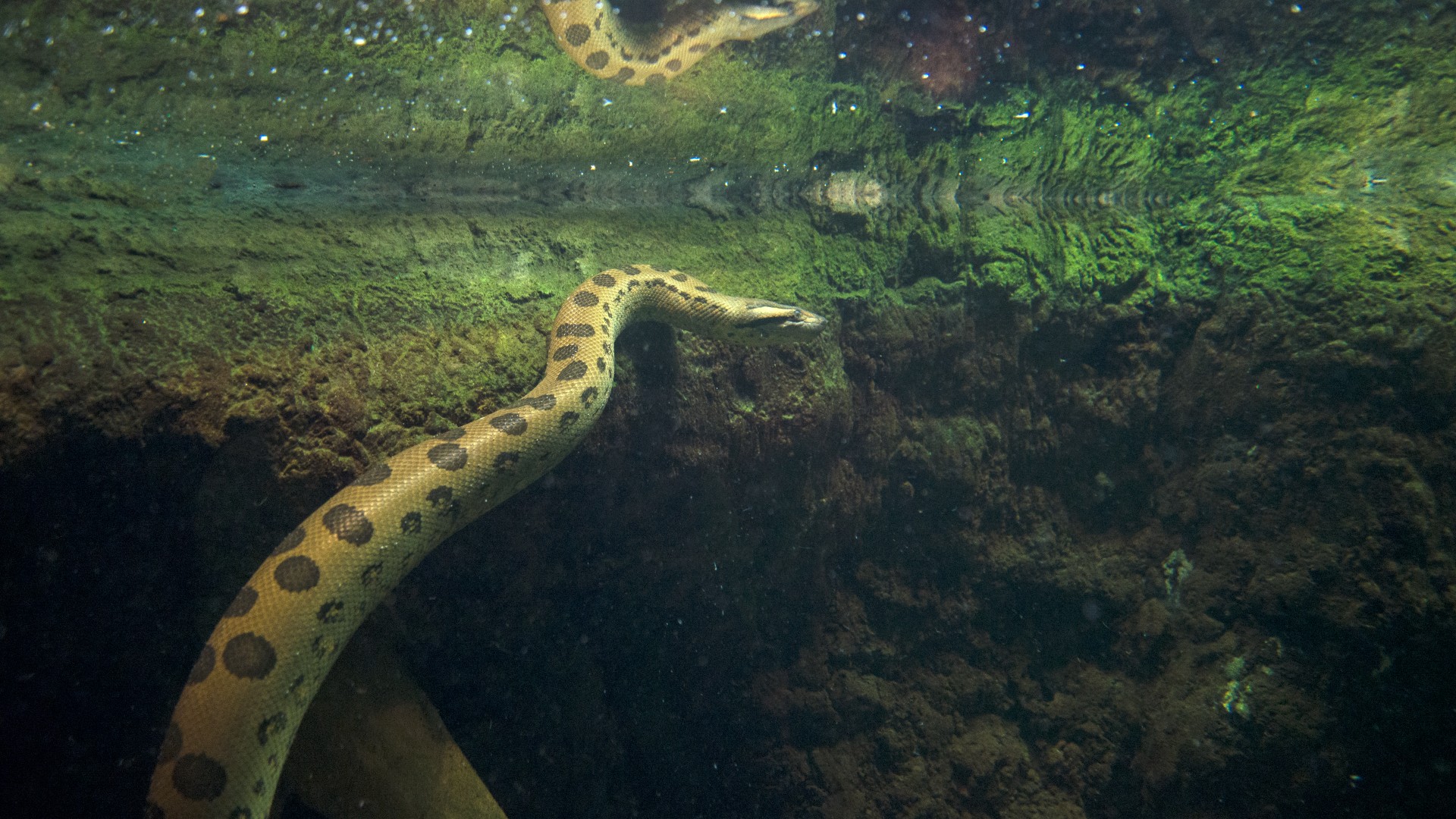
Anacondas live in tropical rivers and swamps, either in the rainforests or grasslands. They thrive in the heat, humidity and dense leafage of the rainforest, according to the San Diego Zoo.
They spend most of their fourth dimension swimming or lurking in murky, sluggish rivers and slow-moving streams. They sun themselves on branches hanging over water, which they can easily drib into if needed, according to All Things Nature.
Behavioral habits
Anacondas are almost active in the early evening and at night. Their large size makes them cumbersome on country but they tin movement swiftly in the water. They are lonely snakes and green anacondas take their ain habitation territories, ADW states. They are adjustable, and snakes that live in grasslands sometimes by themselves in mud and become dormant during the dry season.
Anaconda hunting
Anacondas, similar all boas, are non venomous. "Anacondas are powerful constrictors," said Heyborne. "They chase for a diversity of prey items typically under the cover of darkness." Anacondas usually lurk in rivers near the banks, where the murky waters and their camouflaging coloring conceals them, waiting for prey to come to beverage. So, they attack. They restrain their prey with their abrupt, curved teeth and apply their constrictive killing technique.
In that location are some common misconceptions near how that constricting works, said Heyborne. 1 is that it crushes or breaks the bones of the prey. Another is that the snakes suffocate it, squeezing the prey'south lungs too tightly to work. Scientists held this conventionalities until quite recently, when a paper published in the Periodical of Experimental Biology revealed what happens to prey animals during constriction. "It turns out that the squeezing overwhelms the circulatory system," explained Heyborne. "Blood cannot get to the brain, and the creature dies inside seconds due to ischemia." Since anacondas typically constrict their casualty in the water, drowning is also a common cause of death.
Anacondas eat a multifariousness of animals. "Modest snakes may take rodents, lizards and fish, while adult snakes may take caiman, capybara or even jaguar," Heyborne said. Female anacondas sometimes consume males.
In one case the prey is dead, anacondas eat it whole. They take a large, unfused ligament on each side of their mandibles and mobile joints in their jaws that permit them to open their jaws wide enough to become effectually large casualty. Their stretchy skin and lack of sternum allows their body to alter shape to accumulate their dinner, co-ordinate to Rivas.Dark-green anacondas are noon predators, pregnant that they are at the height of their food chain, according to ADW. Sometimes, however, going after large animals similar jaguar and caiman tin can upshot in serious injuries or decease.
After feeding, anacondas can get weeks or months without eating once again, according to National Geographic.
Reproduction and lifespan
During the leap, females leave a odor trail or emit an airborne chemical to concenter males. While females stay in more or less the aforementioned location during mating season, males travel smashing distances to notice females. Males accept been observed sticking out their tongues to selection up female scents, says San Diego Zoo.
Similar much of their lives, anaconda mating takes place in or near the water, co-ordinate to Pets on Mom, an animal fact site. Anacondas form breeding assurance, giant serpent swarms in which 2 to 12 males coil around one female and slowly wrestle for the adventure to mate with her. Convenance balls can terminal for equally long as four weeks. Though the males may win by strength, sometimes the female person — who is larger and stronger than the males — chooses who she wants. Females may mate with several males during the season.
After mating, females behave their embryos inside their bodies while they gestate for 7 months. During this time, females practice not feed, possibly because hunting carries the take chances of injury, which could harm the babies. Possibly because carrying babies requires such an energy investment, green anacondas mate every other year or fifty-fifty less often, co-ordinate to Rivas.
"Anacondas are aquatic members of the boa family unit. And, like boa constrictors, give live birth," said Heyborne. Inside the mother, embryos are attached to a yolk sac and surrounded past a membrane. When it is time for them to be born, they are pushed out through the cloaca. They are born still in the membrane and must break information technology. Mothers practice not care for their young, who instinctively know how to survive on their own.
Females typically accept effectually 29 babies, though the number is fewer for smaller anacondas and college for larger ones, according to Rivas.
Anacondas accomplish sexual maturity between 3 and 4 years of historic period, co-ordinate to ADW. In the wild, they live for about 10 years. In captivity, they can alive for up to 30 years.
Conservation and endangerment condition
"Currently, anacondas are not endangered and their numbers announced to be more or less stable," said Heyborne. "However, they do face persecution past humans, as they are ofttimes killed on site due to fear of human being ingestion." Human ingestion is unlikely and humans should non kill anacondas. Still, Heyborne said that anacondas' "biggest threat is undoubtedly the loss of suitable habitat as tropical forests are felled for timber or agriculture."
Can anacondas eat humans?
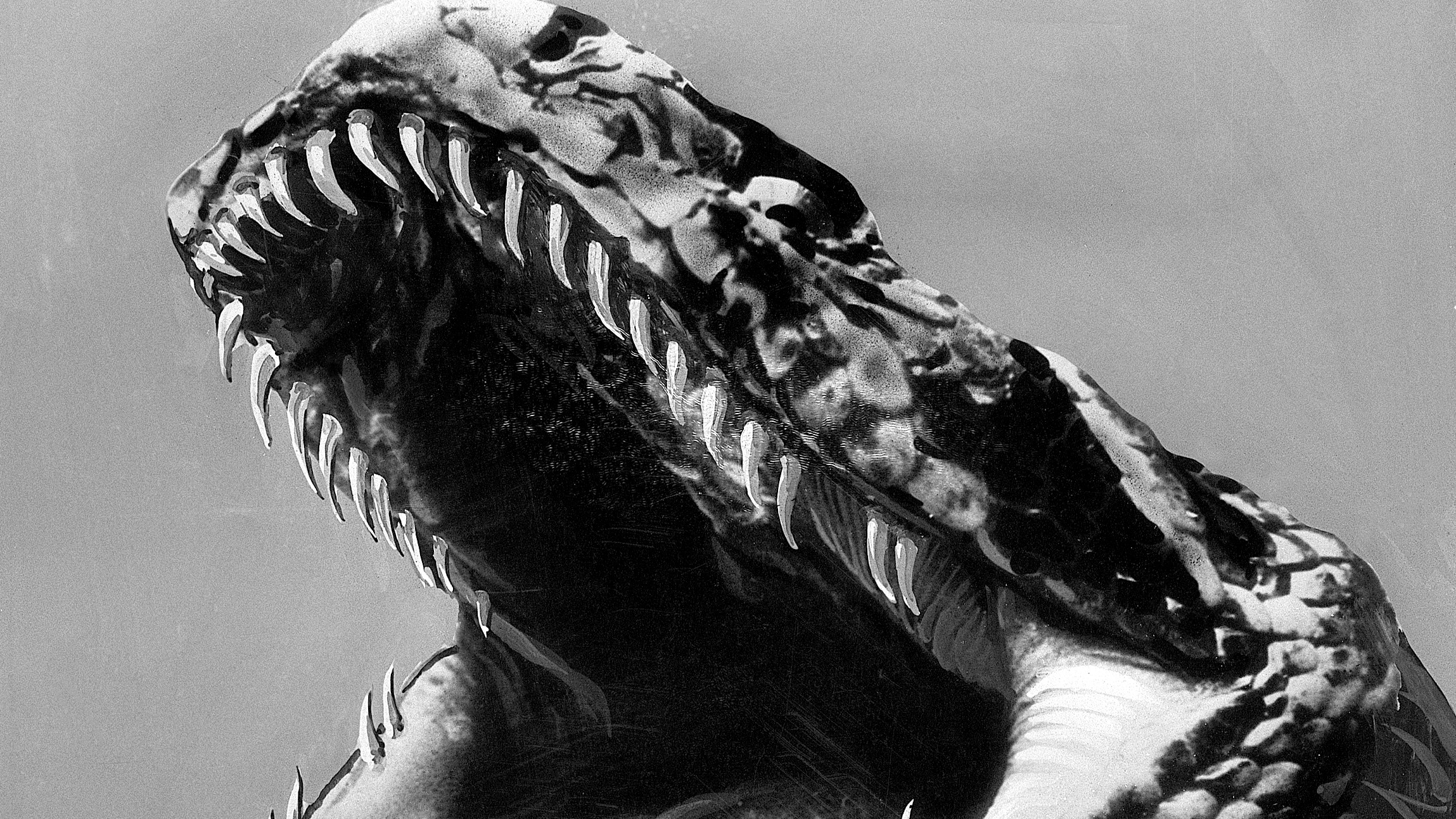
Anacondas have a legendary status as homo eaters. There have been reports of humans existence eaten by anacondas, though none accept been verified. The scientific consensus is, nevertheless, that an anaconda could swallow a human. They eat prey that is tougher and stronger than humans, according to Rivas. Green anacondas are known to consume white-tailed deer, which weigh well-nigh 120 lbs. (54 kg), and then information technology is reasonable to assume they could eat a human being of at to the lowest degree the same size.
Rivas recounted two stories of his researchers being predatorily attacked by anacondas and surviving. He emphasized that these researchers had spent a good amount of fourth dimension in anaconda territory, so the snakes were abnormally exposed to humans. Normally, anacondas and humans rarely encounter each other in the wild and humans are not typical anaconda prey.
In December 2014, The Discovery Channel aired a special chosen "Eaten Alive," in which a man was to be eaten by a green anaconda. Naturalist Paul Rosolie wore "snake-proof" trunk armor designed to withstand the snake's fangs, constriction and digestion then he would survive the ordeal. If the stunt had gone as planned, the anaconda may have regurgitated Rosolie, or the crew would have cut the snake open to get Rosolie out. It didn't work, however.
The anaconda was not interested in eating Rosolie, peculiarly not in his special suit. The accommodate was doused in squealer blood to make him a more than appealing meal, but when Rosolie approached, the snake was afraid and tried to abscond. Rosolie and then provoked the snake and it somewhen attacked. It began constricting Rosolie, who worried that it was going to pause his arm. He cried out in fearfulness and pain and asked the coiffure to rescue him.
Additional resources
Detect more about Jesus Rivas piece of work at' Anacondas.org. The Smithsonian national zoo contains a full factfile on Green Anacondas including an interesting Fact Sheet which tin be found here. Similarly, San Diego Zoo has lots of Anaconda information.
Bibliography
- Mythology.net
- Loren Coleman and Jerome Clark'due south "Cryptozoology A to Z" (Simon and Schuster, 1999)
- Reptiles Cove
- Academy of Michigan's Animal Diversity Web
- Naomi Bolton "How Snakes Suit in the Forest" Sciencing (22nd November 2019)
- Jacksonville Zoo
- "Why Do Snakes Shed Their Skin?" Wonderopolis
- "Green Anaconda" National Geographic
- William East. Duellman "The Lives of Amphibians and Reptiles in an Amazonian Rainforest" (Cornell, 2005)
- Boas and Pythons of the Earth
- Earth Atlas
- Charlotte Penhaligan in "Snakes: Essential Wildlife" (Character 19, 2021)
- International Union for Conservation of Nature
- Integrated Taxonomic Information System (ITIS
Source: https://www.livescience.com/53318-anaconda-facts.html
0 Response to "When Does a Baby Anaconda Have to Find Their Own Food"
Post a Comment