Son of Oddyssey Odyssey Strikes Again

Telemachus departing from Nestor, painting past Henry Howard (1769–1847)
Telemachus ( tə-LEM-ə-kəs; Ancient Greek: Τηλέμαχος, romanized: Tēlemakhos , lit.'far-fighter'), in Greek mythology, is the son of Odysseus and Penelope, who is a key character in Homer'southward Odyssey. When Telemachus reached manhood, he visited Pylos and Sparta in search of his wandering father. On his return to Ithaca, he plant that Odysseus had reached home earlier him.
The start four books of the Odyssey focus on Telemachus's journeys in search of news about his father, who has yet to render home from the Trojan State of war, and are traditionally given the title the Telemachy.[1]
Etymology [edit]
Telemachus's name in Greek ways "far from battle", or possibly "fighting from afar", as a bowman does.[2]
Odyssey [edit]
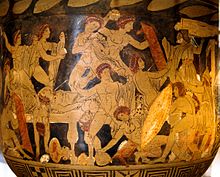
Slaughter of the suitors by Odysseus and Telemachus, Campanian crimson-figure bell-krater, ca. 330 BC, Louvre (CA 7124)
In Homer's Odyssey, Telemachus, under the instructions of Athena (who accompanies him during the quest), spends the first four books trying to proceeds knowledge of his male parent, Odysseus, who left for Troy when Telemachus was however an babe. At the first of Telemachus' journey, Odysseus had been absent from his home at Ithaca for twenty years due to the Trojan State of war and the intervention of Poseidon. During his absenteeism, Odysseus' house has been occupied past hordes of suitors seeking the hand of Penelope.[iii] Telemachus first visits Nestor and is well received past the old man who regales him with stories of his begetter's celebrity. Telemachus then departs with Nestor'southward son Peisistratus,[4] who accompanies him to the halls of Menelaus and his married woman Helen. Whilst there, Telemachus is again treated as an honored invitee as Menelaus and Helen tell complementary notwithstanding contradictory stories of his father's exploits at Troy.[v]
Telemachus focuses on his father's return to Ithaca in Book XV. He visits Eumaeus, the swineherd, who happens to exist hosting a disguised Odysseus. After Odysseus reveals himself to Telemachus due to Athena's communication, the two men plan the downfall of the suitors. Telemachus then returns to the palace to keep an middle on the suitors and to await his father as the ragamuffin.[6]
When Penelope challenges the suitors to string Odysseus' bow and shoot an arrow through the handle-holes of twelve axe heads, Telemachus is the kickoff to attempt the task. He would have completed the task, nigh stringing the bow on his fourth attempt; however, Odysseus subtly stops him earlier he tin finish his effort. Post-obit the suitors' failure at this task, Odysseus reveals himself and he and Telemachus bring swift and bloody decease to the suitors.[seven]
Telegony [edit]

Statue depicting Telemachus
The Telegony was a short two-book epic poem recounting the life and decease of Odysseus subsequently the events of the Odyssey. In this mythological postscript, Odysseus is accidentally killed by Telegonus, his unknown son by the goddess Circe. After Odysseus' death, Telemachus returns to Aeaea with Telegonus and Penelope, and in that location marries Circe.
From the Dictionary of Greek and Roman Biography and Mythology:
Telemachus: The son of Odysseus and Penelope (Hom. Od. i. 216). He was still an infant at the time when his father went to Troy, and in his absence of nearly twenty years he grew upward to manhood. After the gods in quango had determined that Odysseus should return dwelling from the island of Ogygia, Athena, assuming the appearance of Mentes, male monarch of the Taphians, went to Ithaca, and brash Telemachus to eject the troublesome suitors of his female parent from his house, and to go to Pylos and Sparta, to gather information concerning his male parent. Telemachus followed the advice, but the suitors refused to quit his house; and Athena, in the class of Mentes, accompanied Telemachus to Pylos. There they were hospitably received past Nestor, who also sent his own son to comport Telemachus to Sparta. Menelaus again kindly received him, and communicated to him the prophecy of Proteus apropos Odysseus (Hom. Od. i.–iv.).
From Sparta Telemachus returned home; and on his arrival there, he found his father, with the swineherd Eumaeus. But as Athena had metamorphosed him into a beggar, Telemachus did not recognise his father until the latter disclosed to him who he was. Father and son now agreed to punish the suitors; and when they were slain or dispersed, Telemachus accompanied his father to the anile Laertes. (Hom. Od. xv.–xxiv.; comp. Odysseus.)
In the post-Homeric traditions, we read that Palamedes, when endeavouring to persuade Odysseus to join the Greeks against Troy, and the latter feigned idiocy, placed the infant Telemachus before the turn with which Odysseus was ploughing (Hygin. Fab. 95; Serv. ad Aen. ii. 81; Tzetz. ad Lycoph. 384; Aelian, V. H. thirteen. 12.).
According to some accounts, Telemachus became the father of Perseptolis either by Polycaste, the daughter of Nestor, or by Nausicaa, the daughter of Alcinous (Eustath. advertizement Hom. p. 1796; Dict. Cret. vi. vi.). Others relate that he was induced past Athena to ally Circe, and became past her the father of Latinus (Hygin. Fab. 127; comp. Telegonus), or that he married Cassiphone, a daughter of Circe, only in a quarrel with his mother-in-law he slew her, for which in his turn he was killed by Cassiphone (Tzetz. ad Lycoph. 808.). He is also said to have had a daughter called Roma, who married Aeneas (Serv. advertisement Aen. i. 273.).
1 account states that Odysseus, in consequence of a prophecy that his son was dangerous to him, sent him abroad from Ithaca. Servius (ad Aen. x. 167) makes Telemachus the founder of the boondocks of Clusium in Etruria.[8]
[edit]
In Competition of Homer and Hesiod, information technology is alleged that the Roman Emperor Hadrian asked the Delphic Oracle near Homer's birthplace and parentage. The Oracle replied that Homer came from Ithaca and that Telemachus was his begetter past Epicasta, daughter of Nestor.[nine] [x]
According to Aristotle and Dictys of Crete, Telemachus married Nausicaa, King Alcinous' daughter, and fathered a son named Perseptolis or Ptoliporthus.[11]
Other appearances [edit]
Telemachus is the subject of François Fénelon's The Adventures of Telemachus, Son of Ulysses (1699), a scathing attack on the monarchy of France.
Telemachus was the subject of numerous operas throughout the eighteenth century, most based on Fénelon'southward version.[12] Amongst the well-nigh famous of these operas were André Primal Destouches's Télémaque (1714), Alessandro Scarlatti'southward Telemaco (1718), Gluck's Telemaco, ossia L'isola di Circe (1765), Giuseppe Gazzaniga's Gli errori di Telemaco (1776), Jean-François Le Sueur's Télémaque dans l'île de Calypso ou Le triomphe de la sagesse (1796), Simon Mayr's Telemaco nell'isola di Calipso (1797), and Fernando Sor's Telemaco nell'isola di Calipso (1797).
Telemachus is ane of the main characters in Ulysses, a 1705 play by Nicholas Rowe.
Telemachus is featured in the 1833 verse form (published in 1842) "Ulysses" by Alfred, Lord Tennyson.
In the 1922 novel Ulysses by James Joyce, Stephen Dedalus is generally regarded as respective to Telemachus.
"Telemachus" is the title of Book Three of Thomas Wolfe'south autobiographical novel Of Fourth dimension and the River (1935).
Joseph Brodsky published the verse form "Odysseus to Telemachus" in 1972.
Telemachus is a frequent character in the poetry of Louise Glück.[13]
Telemachus was the proper name of Carole King'south cat and is pictured on the cover of her album Tapestry.[fourteen]
Telemachus appears as the son of Ulysses in the 1981 French-Japanese animated television series Ulysses 31.
Telemachus is a major grapheme in Madeline Miller'south novel Circe. He eventually marries and has children with Circe.
Telemachus is the title of a poem by American poet Ocean Vuong.[15]
"Telemachus Sneezed" is the proper name of a fictional novel in The Illuminatus! Trilogy. and is a parody of the championship of Ayn Rand'due south novel, Atlas Shrugged.
Telemachus is the pretend proper name begetter "Bandit Heeler" uses in the "Infirmary" and "Tickle Crabs" episode of the animated series "Bluey".
Notes [edit]
- ^ The Odyssey. George Herbert Palmer, 1921, prose.
- ^ Brann, p. 277.
- ^ Homer, Odyssey Books I–Ii
- ^ Homer Odyssey Volume Three
- ^ Homer Odyssey Book IV
- ^ Homer, Odyssey Books XV–Xvi
- ^ Homer, Odyssey Books XXI–XXII
- ^
 Schmitz, Leonhard (1870). "Telemachus". In Smith, William (ed.). Dictionary of Greek and Roman Biography and Mythology. Vol. III. p. 989.
 - ^ "Hesiod, The Homeric Hymns, and Homerica" (Competition of Homer and Hesiod)
- ^ Parke, Herbert William (1967). Greek Oracles. pp. 136–137 citing the Certamen, 12.
- ^ Allan, Arlene (2010). "The Authorization of Telemachus". Classical Antiquity. 19 (i): 14–30. doi:x.1525/CA.2014.33.1.31.
- ^ Monson, Dale Due east. (2001). "Telemachus". In Sadie, Stanley; Tyrrell, John (eds.). The New Grove Dictionary of Music and Musicians (2nd ed.). London: Macmillan.
- ^ Meadowlands (1996), summary
- ^ Chocolate-brown, Helen (7 March 2016). "Carole King interview: 'I didn't have the backbone to write songs initially'". The Telegraph.
- ^ "Archived copy". Archived from the original on 2018-09-05. Retrieved 2018-09-05 .
{{cite web}}: CS1 maint: archived copy as title (link)
References [edit]
- Brann, Eva, Homeric Moments: Clues to Delight in Reading the Odyssey and the Iliad, Paul Dry out Books, 2002. ISBN 9781589882805.
- Homer, The Odyssey with an English Translation by A.T. Murray, PH.D. in two volumes. Cambridge, MA., Harvard University Press; London, William Heinemann, Ltd. 1919. Online version at the Perseus Digital Library.
External links [edit]
 | Wikimedia Eatables has media related to Telemachus. |
- Telemachus – Τηλέμαχος, Carlos Parada at the Greek Mythology Link
Source: https://en.wikipedia.org/wiki/Telemachus
0 Response to "Son of Oddyssey Odyssey Strikes Again"
Post a Comment