Can You Kill the Egg Baby in Egg the Game

Partially shelled balut egg showing yolk, baby chicken and veins running through it
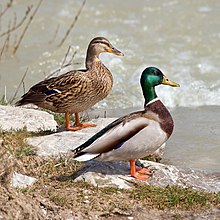
Mallard ducks are used extensively in the production of balut—female (left) and male (right)
Balut ( bə-Boodle , BAH-loot;[1] as well spelled every bit balot) is a fertilized developing egg embryo that is boiled and eaten from the shell. It is normally sold equally street nutrient in Due south China and Southeast Asian countries, notably the Philippines, Cambodia (Khmer: ពងទាកូន, paung tea kaun ) and Vietnam (Vietnamese: trứng vịt lộn). The term comes from the Filipino linguistic communication.
The length of incubation before the egg is cooked is a affair of local preference, just more often than not ranges between fourteen and 21 days.
Description [edit]

Veins in a freshly boiled, peeled balut egg
A balut is a fertilized bird egg (ordinarily a duck) which is incubated for a menses of 14 to 21 days, depending on the local culture, so steamed. The contents are eaten straight from the shell. Balut that is incubated for longer periods take a well-developed embryo and the features of the duckling are recognizable. The partially-developed embryo basic are soft enough to chew and swallow as a whole. The mallard duck (Anas platyrhynchus), also known equally the "Pateros duck", is oft used to make balut.[2] [three]
Balut is mutual street food in the Philippines and other localities, and is besides sold in stores and malls. It is a relatively cheap source of protein and calcium.[4] Balut was introduced to the Philippines past the Chinese in 1565[5] or around 1885 and since then, balut has been included as a traditional part of the culture.[6] Wherever Filipinos migrated for work, a large market place for balut would develop. Controversies arose as knowledge of the food spread around the Southeast Asian countries so globally. People questioned the ethics of eating balut.[6]
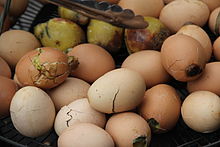
Balut in partially broken shells
Preparation [edit]

Closeup of balut after removing the crush
Traditionally, the fertilized eggs are incubated in the sun or buried in sand, and stored in baskets to retain warmth. In order for the embryo to develop commonly, it must be exposed to estrus for the correct flow of time, while ensuring that the temperature is not too hot to harm the eggs or also common cold to permit growth.[vii] The embryo is very sensitive to loftier temperatures, and is easily killed upon cooking in the sun.[vii] After nine days, the eggs are held to a lite, in a process called candling, to reveal the embryo inside. The production of balut depends on egg maturation cycles, where the egg begins developing and changes in texture. Throughout these various maturation periods, different temperatures are required to accentuate the specific egg and embryo characteristics. Within the first few stages of maturation, balut is known every bit "balut sa puti" ("wrapped in white") when it is white; the embryo inside is insufficiently developed to show a beak, feathers or claws, and the bones are undeveloped. These are made from very specific egg types, less than v days sometime and with no visible surface cracks.[8]
The elapsing of egg incubation is a affair of local preference. In the Philippines, balut is generally incubated for 14 to eighteen days earlier being boiled for consumption. At about xiv to 16 days of incubation, the embryo floats on top of the egg white and yolk, and the balut is called "mamatong".[6] The ideal balut is said[ past whom? ] to be 17 days onetime.
There are other versions of balut. In the Cambodian version, pong tea khon, the egg is incubated for 18 to twenty days. In the Vietnamese version, trứng vịt lộn, the egg is incubated for 19 to 21 days, when the embryo is old enough to be recognizable as a baby duck and has bones that will be firm but tender when cooked. Some men prefer to swallow an embryo that is much more adult, "...and then that it looks gross, because that is a way to prove your manhood."[9] [10]
Chemical science of cooking [edit]
During the cooking process, changes occur in the nutrient chemical science of balut, such as the sol dispersion of water molecules inside the embryonic fluid.[xi] This liquid becomes the broth for the solid which are parts of the duck inside the egg. Although balut mainly consists of protein, fat is present and is emulsified within the fertilized embryo. Subsequently cooking, it tin can be considered a protein gel (depending on the length of time it was cooked). Heating high-poly peptide food such as balut can crusade the chemic changes to accept place and fully or partially denature proteins, causing the surface to become thick and causing an irreversible gel protein to class.[11]
Temperature has a significant impact on the final taste and texture of the cooked balut. Warm temperatures of 29–30 °C (84–86 °F) modify the taste and texture of the yolk by making it more grainy. This tin can be attributed to the changes in proteins, and their partial denaturation, during the heating and incubation procedure.[12] When boiling or cooking eggs, the white of the egg tends to solidify because the proteins are denatured in an irreversible reaction and turn from transparent to an opaque white.[13] Concrete and chemical changes in the concluding balut production can also be attributed to microbial infections and the charge per unit that microbes infect the balut at diverse stages.[12]

Balut from Vancouver, British Columbia
At that place are many chemic changes that occur within the duck egg equally information technology is beingness candy, which tin can vary depending on how or what it is cooked with. While boiling, added table salt can contribute to a number of chemical changes; it seems to increment the proportional weight of egg white within the vanquish, which can be due to the weight differences between the embryo and the egg white itself.[14] Added common salt can also increase the hardness of the egg yolk and affect the overall texture of the last balut production.[7] Other chemic changes observed in food content of the duck egg every bit it is processed are a slight decrease in the amount of available amino acids, h2o-soluble vitamins and minerals after the processing is consummate.[fourteen]
Nutrition [edit]

There are different nutritional values for balut, since it tin be either fertilized chicken or duck eggs. Balut diet specifications between chicken and duck have small-scale differences, but both eggs take effectually 14 grams of crude protein, 188 calories each, and effectually 100 milligrams of calcium. A duck egg might have a higher value of nutrition than a craven egg just overall, both chicken and duck balut accept approximately the same nutritional value.[15]
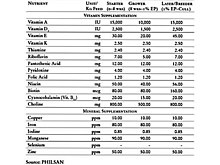
Nutrition specifications for egg-type duck (balut)
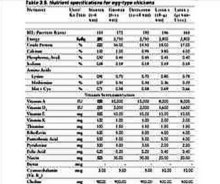
Nutrition specifications for egg-type chicken (balut)
Dishes and vending [edit]

In the Philippines, balut eaters prefer salt, or a chili, garlic, and vinegar (white or coconut sap, sometimes cane) mixture to season their eggs.[sixteen] The eggs are savored for their balance of textures and flavors; the goop surrounding the embryo is sipped from the egg before the beat out is peeled, and the yolk and young chick inside can be eaten. All of the contents of the egg may be consumed, although the white albumen may remain uneaten depending on the age of the fertilized egg. This white albumen may accept an unappetizing cartilaginous gustation and is tough and rubbery in texture. In the Philippines, balut take recently entered haute cuisine by being served equally appetizers in restaurants, cooked adobo style, fried in omelettes or even used as filling in broiled pastries. In Vietnam, balut is eaten with a compression of pepper common salt with lime/kumquat or ginger and rau răm (besides known as laksa leaf). In Kingdom of cambodia, balut is eaten while withal warm in the shell and served with nothing more than a little garnish, which is usually a mixture of lime juice and footing pepper.
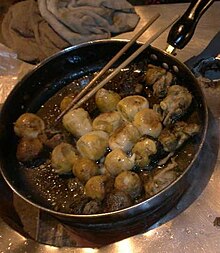
A similar preparation is known in People's republic of china every bit maodan (Chinese: 毛蛋; pinyin: máo dàn ; lit. 'feathered egg'), modan (Chinese: 末蛋; pinyin: mò dàn ; lit. 'end-stage egg'), wangjidan (Chinese: 旺雞蛋; pinyin: wàng jīdàn ; lit. 'flush egg') or huozhuzi (Chinese: 活珠子; pinyin: huózhūzi ; lit. 'living dewdrop'). Chinese traders and migrants are said to have brought the thought of eating fertilized duck eggs to the Philippines. However, the knowledge and craft of balut-making has been localized by the balut-makers (magbabalut). Today, balut production has non been mechanized in favor of the traditional production by hand.
Vendors sell cooked balut from buckets of sand (used to retain warmth) accompanied past small-scale packets of salt. Uncooked balut are rarely sold in Southeast Asia. In the The states, Asian markets occasionally carry uncooked balut eggs. Alternatively, they tin be ordered by mail. The cooking process is identical to that of hard-boiled chicken eggs, and baluts are eaten while still warm.
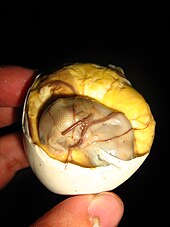
Underaged balut with visible chick
Duck eggs that are not properly developed after nine to twelve days are sold as penoy, which look, smell and taste similar to a regular difficult-boiled egg. In Filipino cuisine, these are occasionally browbeaten and fried, similar to scrambled eggs, and served with a vinegar dip.
Consumption and uses [edit]
Locations of balut consumption [edit]
Balut is consumed in high amounts inside countries in Southeast Asia, including Laos, Kingdom of cambodia, Vietnam, Thailand, and the Philippines.[17] Pateros is a starting time-class municipality in Metro Manila, Philippines that is famous for its duck-raising industry and balut production. The Pateros municipality was really named for its duck farmers by speakers of Spanish.
Balut is recognized as a national food of the Philippines, merely possibly originated from Red china. It is said that an early on form of balut was brought by Chinese traders and migrants to the Philippines; the Chinese may have sparked the interest and excitement for the Philippines' love of balut. It is commonly sold as a street nutrient and served as an titbit in restaurants. The sense of taste of balut is like to chicken soup. It has an unusual texture.
Balut is plant in some countries and locations of Due north America. While it cannot be found in every store in North America, specialty stores such every bit T&T, and, in detail, Filipino stores in the Greater Vancouver area, often sell balut.[18] In the Usa, growers such as Metzer Farms specialize in balut production, spreading the knowledge of balut and its awareness.
A reason information technology may not be constitute or consumed as often in Due north America is that the majority of people outside of Southeast Asia still recognize balut as a novel and taboo nutrient and oft are anxious virtually trying it.[17]
Consumption [edit]
In the Philippines, balut is oftentimes eaten with table salt or a chili, garlic and vinegar (white or kokosnoot sap) mixture to season, depending on personal preference.[19] Balut tin can exist served in many means and may be cooked, boiled, and fried. Information technology may be cooked adobo-style, fried in omelets, and used as filling in pastries.
Some countries and locations will serve balut raw, although this is not a common practice. "Raw," in this sense, could mean the balut was lightly boiled or cooked very briefly.[xix] This is potentially dangerous since information technology increases the chance of spoiling and of ingesting harmful microorganisms.[half-dozen]

Although balut is globally recognized as a Filipino food, it is being consumed less and less in the Philippines. This is partly due to increasingly Western tastes, but besides because balut is often associated with poverty.[9]
In Saigon, Vietnam, balut can be found in the streets where vendors operate on the back of motorbikes in alleys. Balut is served every bit quail eggs. First it is steamed and so served with table salt, chilli and pepper.
Incubation and storage [edit]

Balut egg purchased from Vancouver supermarket, with different labeling requirements than traditional chicken eggs
Balut is considered to be a street food, and equally with many street foods, balut should be eaten equally shortly as information technology is prepared. Sources suggest that at most, the shelf-life of a cooked balut is i twenty-four hours, but can exist kept in the refrigerator for up to one week.[20]
According to the FDA Food Code, balut tin can perish over fourth dimension or due to temperature changes. After being cooked, balut should be handled either at 57 °C (135 °F) and above, or kept at or below five °C (41 °F).[21]
While about countries accept specific regulations and standards for food, Canada has certain egg regulations pertaining to what products tin can be labelled as an egg. Balut eggs are not subjected to the egg regulations in Canada nether the Canadian Food Inspection Bureau, meaning they practice not require the specific labeling requirements and rules of the traditional chicken egg.[21]

Religion prohibitions [edit]
Eating balut is forbidden for some religious groups. Both Judaism and Islam accept strict prohibitions on consuming food that is prepared in manners incompatible with religiously-prescribed dietary laws. In Judaism, the embryo of a chick inside an egg of a bird, even a kosher bird, is forbidden for consumption.[22] The Quran forbids consumption of meat if the creature has not been slaughtered properly, making the animal or animal-production "maytah".[20] [23] Because balut is an egg containing a partly-developed embryo,[24] this makes it "haram", or "forbidden".[23] [25] [26]
In Christianity, the Members Church building of God International forbids their members to eat "balut" for information technology is written in Acts 15:twenty, "But that nosotros write unto them, that they abstain from pollutions of idols, and from fornication, and from things strangled, and from blood." Co-ordinate to them, the word "strangled" refers to those animals who died without pouring its blood upon the ground every bit written in Deut. 15:23.[ commendation needed ] "Only grand shalt non eat the blood thereof; thousand shalt pour it upon the ground equally water."
Brute welfare [edit]
Information relating to whether boiling a partially-developed embryo is ethically adequate or non can be found in the legislation relating to the euthanasia and treatment of inquiry animals. Bird embryos that have reached greater than 50% of their incubation have adult a neural tube sufficient for pain perception; therefore, they should be euthanized by similar methods used in avian neonates such as coldhearted overdose, decapitation, or prolonged exposure to carbon dioxide.[27] Similarly, in the UK, embryonic birds are "protected animals" once they have reached the last 3rd of their incubation period.[28] There are specified methods of humanely killing protected animals used in inquiry, only boiling is not one of these. Depending on the species of duck, some eggs used for balut would be boiled within the last half or 3rd of embryo development. Duck embryos are frequently taken off incubation in society to stunt the growth process; the embryos no longer develop, and become readily available for purchasing. The RSPCA Australia recommends against boiling the duck embryo from the 18th 24-hour interval of incubation onwards due to the potential for suffering beyond that betoken, and notes that information technology is "an area that is all the same to be further researched".[29]
Several groups[ who? ] wish to ban balut.[30] A petition has been raised to go 5,000 signatures to accept balut labeled "fertilized duck egg with embryo" and taken off the menu in the Maharlika eating house, New York.[31] As of 2014[update], the eatery was selling balut for $v each.[32] As a response to this petition, Filipino New Yorkers accept created a counter petition request to leave the nutrient item alone.[26]
Health [edit]
The incubation temperatures and surroundings required for the proper development of balut during processing are ideal growth conditions for many bacteria including Salmonella enteritidis. In add-on, faecal pathogens can exist deposited on the egg trounce surface during laying. Balut is therefore labelled as a "Chancy Food" in Canada.[33] Warnings have been published to obtain balut only from safety, well-known producers.[33]
Outside Southeast Asia [edit]
Outside of Southeast Asia, balut has been featured on reality television receiver shows, such as in season 1 of Bizarre Foods with Andrew Zimmern, or as office of eating challenges, such as on Fearfulness Factor in 2002, Hell's Kitchen in 2013, The Amazing Race Asia two, The Amazing Race Australia 2, The Amazing Race Ukraine, Survivor: Palau, Survivor: Cathay, Survivor: Caramoan, and Survivor: Cambodia.[34] [35]
In the United States, eggs are sold at Asian markets. All the same, to get the right historic period eggs and to ensure freshness, it is recommended[ by whom? ] that they be purchased from a professional or an egg vendor at Asian farmers markets.
Folk medicine [edit]
According to pop Vietnamese belief, these eggs are a nutritious and restorative food for significant or delivering women.[36]
Guinness World Record [edit]
On April 10, 2015, former Pateros mayor Jaime C. Medina collaborated with Eye for Culinary Arts (CCA, Manila) and the History Channel to attempt to set the record for the world'southward largest serving of balut. The CCA chefs, headed past Tristan Encarnacion, prepared 1,000 pieces of balut into an adobo dish that was recorded to accept weighed 117.5 kilograms. The resulting dish was enjoyed by the townsfolk in a symbolic boodle fight, with tables topped with banana leaves stretching along B. Morcilla Street.[37] [38]
The record was subsequently awarded to Pateros, Metro Manila and to this date, the record still stands.[39]
See as well [edit]
- Balut (game) – Dice game
- Century egg – Chinese egg-based culinary dish
- Isaw
- Kikiam – Hokkien and Teochew dish widely adapted in Malay and Republic of indonesia
- Kutti pi
- List of delicacies – Food detail that is considered highly desirable in sure cultures
- Salted duck egg
- Smoked egg – Nutrient that involves the smoking of eggs
- Soy egg – Egg dishes
- Tea egg – Egg boiled in tea every bit a savory snack
- Kwek-Kwek – Filipino street nutrient
References [edit]
- ^ "Definition of BALUT". www.merriam-webster.com . Retrieved April xxx, 2018.
- ^ Romjali, East.North.; Lambio, A.Fifty.; Luis, Eastward.S.; Roxas, Due north.P.; Barion, A.A. (2014). "Fertility and hatchability of eggs on mallard ducks (Anas platyrhynchos L.) of dissimilar plumage design under different feeding regimes". JITV. 19 (3): 674–678.
- ^ Alejandria, Maria Carinnes P.; De Vergara, Tisha Isabelle 1000.; Colmenar, Karla Patricia K. (Nov 25, 2019). "The authentic balut: history, culture, and economic system of a Philippine food icon". Journal of Ethnic Foods. vi (ane): xvi. doi:x.1186/s42779-019-0020-viii. ISSN 2352-6181.
- ^ Magat, Margaret (2007). "'Balut,' the Fertilised Duck Eggs of the Philippines". In Hosking, Richard (ed.). Eggs in Cookery: Proceedings of the Oxford Symposium of Nutrient and Cookery 2006. Prospect Books. ISBN978-1-903018-54-v.
- ^ Zaide, Gregorio (1964). History of the Filipino People. Manila: Modernistic Book Co.
- ^ a b c d Magat, Margaret (January 1, 2002). "Balut: "Fertilized Duck Eggs and Their Role in Filipino Civilisation"". Western Folklore. 61 (1): 63–96. doi:10.2307/1500289. JSTOR 1500289.
- ^ a b c R. Ehrlich, Paul. "Incubation: Heating Egg." Incubation: Heating Egg. Web. February 29, 2016.
- ^ Matejowsky, T. (2013). "The incredible, edible balut. food, culture and society". International Journal of Multidisciplinary Inquiry. sixteen (3): 387–404.
- ^ a b Liedel, E. (Apr 14, 2014). "Balut: The fertilized duck egg street snack". Modern Farmer.
- ^ "Cracking the shell: Balut revealed | Tangled Noodle". tanglednoodle.blogspot.ca. March thirteen, 2011. Retrieved August fifteen, 2016.
- ^ a b "Class:FNH200/Lesson 02 - UBC Wiki". wiki.ubc.ca . Retrieved March 21, 2016.
- ^ a b "Redirecting..." bulldoze.google.com . Retrieved March 17, 2016.
- ^ BBC. "Cooking and Chemical Changes." BBC News. BBC, n.d. Web. February 29, 2016.
- ^ a b Kaewmanee, Thammarat. "Changes in Chemical Limerick, Physical Properties and Microstructure of Duck Egg every bit Influenced past Salting." Inquiry Gate. N.p., June 11, 2008. Web. February 29, 2016.
- ^ Lambio, A. L. (2010). Poultry Production in the Tropics. Quezon, Diliman, Philippines: The Academy of Philippines Press.
- ^ "What Is a Balut Egg?". The San Francisco Relate.
- ^ a b "In Some Countries People Eat Balut(egg) fertilized duck embryo". 2012. Retrieved Baronial 16, 2016.
- ^ "Best balut in Vancouver. (n.d.)". Retrieved Baronial sixteen, 2016.
- ^ a b Liedel, Emily (April 14, 2014). "Balut: The Fertilized Duck Egg Street Snack - Modernistic Farmer". Retrieved August sixteen, 2016.
- ^ a b "Enhancing the value of eggs: How to brand balut and century eggs". www.fftc.agnet.org . Retrieved August xv, 2016.
- ^ a b "Balut" (PDF). CPHAZ. March 3, 2016. Archived from the original (PDF) on April 4, 2016. Retrieved August fifteen, 2016.
- ^ Kosher And Non-Kosher Eggs Jewish Press. Retrieved December 4, 2018.
- ^ a b "Is eating egg haram / makruh - Multaqa Ahl al-Hadeeth". Baronial 28, 2011. Retrieved August xvi, 2016.
- ^ Tang, Q., Li-Chan, E. C. Y., Byrne, Due south. K., & Cheng, K. M. (due north.d.). Effect of storage temperature on sensory and microbiological quality of duck balut eggs, 4.
- ^ Nutrition, Center for Nutrient Safety and Practical. "Nutrient Code - FDA Food Code 2009: Annex three - Public Health Reasons / Administrative Guidelines - Chapter 1, Purpose and Definitions". www.fda.gov . Retrieved March 20, 2016.
- ^ a b Kilham, Chris (September 15, 2011). "Eating Balut: Going Too Far? | Fox News". Fox News . Retrieved Baronial fifteen, 2016.
- ^ Leary, S.; et al. (2013). "AVMA Guidelines for the Euthanasia of Animals - 2013 edition" (PDF). AVMA. Retrieved March 24, 2016.
- ^ "Consolidated version of ASPA 1986". Home Role (UK). 2014. Retrieved March 24, 2016.
- ^ "Is the practice of boiling pre-hatched duck embryos in their shell humane?". RSPCA Commonwealth of australia knowledgebase . Retrieved October 10, 2016.
- ^ Matejowsky, T. (2013). The Incredible, Edible Balut. Food, Culture and Guild: An International Journal of Multidisciplinary Research, 16(iii), 387–404.
- ^ San Jose, C.Eastward. (April 13, 2015). "Animal rights activist: Stop serving 'balut' in New York". Kicker Daily News . Retrieved March 20, 2016.
- ^ Calderon, J. (2014). "Balut: The Filipino delicacy that makes the earth squirm". CNN. Retrieved March 24, 2016.
- ^ a b Information Sheet (2011). "Balut" (PDF). Academy of Guelph. Archived from the original (PDF) on April 4, 2016. Retrieved March 24, 2016.
- ^ 'Survivor: Caramoan': It'southward Corinne vs. Phillip when the tribes merge
- ^ "Balut gets spotlight in New York". August 5, 2013.
- ^ "Những điều cần lưu ý khi ăn trứng vịt lộn".
- ^ "Philippines in earth record attempt for largest serving of balut". CNN Philippines. Apr 14, 2015. Retrieved April 26, 2018.
- ^ "Pateros optics globe tape attempt for balut". ABS-CBN News. April eleven, 2015. Retrieved April 27, 2018.
- ^ "Largest serving of balut". Guinness World Records. April 10, 2015. Retrieved Apr 25, 2018.
Further reading [edit]
- Davidson, Alan (1999). "Balut". Oxford Companion to Food. Oxford University Press. pp. 53. ISBN0192115790.
- Magat, Margaret (November 2019). Balut: Fertilized Eggs and the Making of Culinary Majuscule in the Filipino Diaspora. Bloomsbury Academic. ISBN9781474280334.
External links [edit]
 | Wikimedia Commons has media related to Balut. |
- How to brand the Hawaiian version of Balut
- Balut : the ugly duckling embryo : The balut in Filipino civilization
- Eating Balut: Going Also Far?
- What is a Balut Egg?
- One-half-hatched Duck Eggs: Hot Vit Lon
- How To Swallow Balut -- The Strangest Food You lot Can Purchase In New York City on YouTube
- Balut | The filipino nutrient effeminateness, a fertilized duck egg on YouTube
- What is balut in Vietnam
Source: https://en.wikipedia.org/wiki/Balut_(food)
0 Response to "Can You Kill the Egg Baby in Egg the Game"
Post a Comment