what does it mean to get paid bi weekly
Payroll
Baseball, apple tree pie, and biweekly pay. Getting paid every other calendar week has go an American tradition, with the U.S. Bureau of Labor Statistics ranking biweekly pay as the country's most popular pay frequency. While most international businesses typically run payroll on a monthly or weekly ground, employers here at home have taken the center-of-the-road approach. As the name suggests, biweekly payroll involves paying employees on a gear up day every other week, resulting in 26 paydays per year, or 27 if it's a leap year. Namely's own client data suggests that Friday is a specially popular choice among companies with biweekly pay, accounting for almost sixty percent of all paydays. Because each month contains a little more than four weeks, twice a year employees will actually receive 3 paychecks a calendar month. Despite this, the biweekly payroll still offer a certain predictability for hourly, full-time employees, who will always accept to submit their timesheets on the aforementioned solar day of the calendar week and will always be paid out for at least fourscore hours. For HR or payroll administrators, it also ways that processing day merely comes in one case every 2 weeks. In payroll processing, the terms "biweekly pay" and "semimonthly pay" are not synonymous. When employees are paid on a semimonthly basis, they're paid twice a calendar month regardless of how many weeks there are. That means 24 pay periods per year, or 2 less than under the biweekly payroll model. Because the 15th and 30th of the month can sometimes autumn on a holiday or weekend, HR and payroll administrators have to be actress diligent to stay on top of processing deadlines and pay dates. This additional variability has made the semimonthly approach less pop with U.Southward. employers, with less than 20 per centum opting to utilize it. There's another reason why biweekly payroll frequently beats out semimonthly: timekeeping. Under the semi-monthly model, timesheet submission deadlines are variable and the amount of actual work days included in any given payroll run can differ. While that may seem like a moot point for salaried, overtime exempt workers, it means a lot to hourly employees—or in other words, the bulk of the country's workforce. Over 78 million Americans (59 pct of the workforce) are paid on an hourly basis. While it may be true that biweekly payroll is the virtually mutual pay wheel, how exercise you know if it's right for your company? There are a number of factors to consider, including your visitor'south industry and average wages. Simply put, each pay frequency comes with its own unique benefits and drawbacks. Your payroll team's option should exist tailored to meet your employees' unique needs. Weekly pay cycles are particularly common in blue collar industries like manufacturing and construction. In contract work, where piece of work can stall suddenly due to permitting issues or a client running out of funds, more frequent paydays offering a certain sense of security. For HR teams, these aforementioned qualities make weekly pay cycles a nightmare to administer. Without the right technology or someone on your team dedicated solely to processing payroll, managing weekly paydays could testify too much of a challenge. In addition to industry, average compensation has a function to play. If the majority of your workforce is nonexempt or earns nether $50,000 a twelvemonth, it may make the nigh sense to opt for biweekly payroll rather than a less frequent approach like semimonthly or monthly. While choosing 1 of the latter options might exist easier for your Hour administrators to handle, it asks a lot from employees to budget for an entire month in accelerate. In other words, more frequent paydays tin help make it easier to pay the bills. Keep in mind that financial health can accept a large impact on employee experience. Are your workforce's needs so diverse that you can't decide? Rather than settle on one arroyo, many companies instead pay their employees under more than 1 frequency. While doing then might audio untenable if you're handling payroll in business firm or with spreadsheets, it's actually a routine ask of nigh payroll vendors. Namely processes over $7 billion in payroll annually, much of it for companies in like situations. To learn how engineering can brand processing payroll easy at any frequency, schedule a demo today.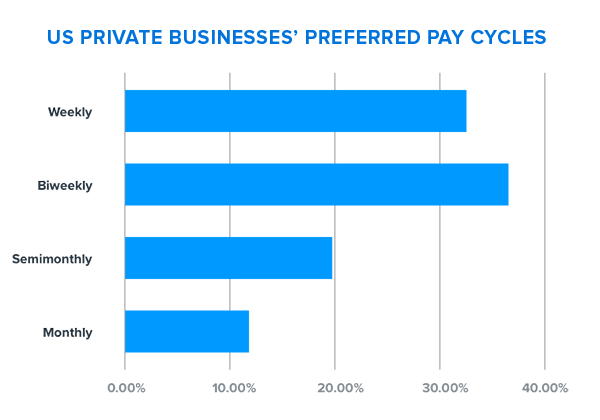
Biweekly vs. Semimonthly
Working overtime trying to pay your employees?
Download Namely'due south Guide to Payroll. Determining Your Pay Frequency
Source: https://blog.namely.com/blog/why-employees-love-biweekly-pay
0 Response to "what does it mean to get paid bi weekly"
Post a Comment